

Measuring Tools
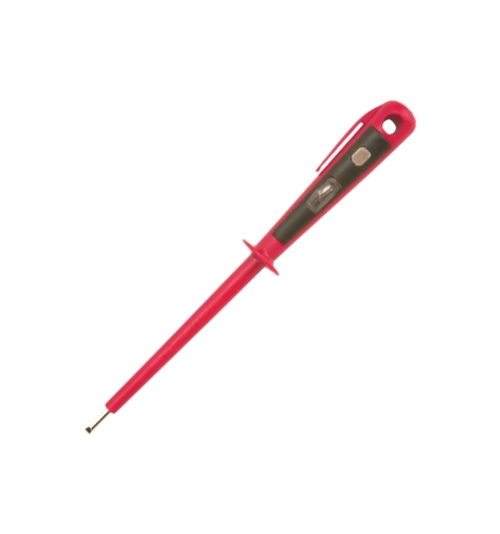
Kennedy Euro Tester - 150mm
With heavy duty one-piece moulded insulation sheaths covering both blade and transparent plastic handle for extra protection and safety. Will detect 'live' electricity supply. Suitable for AC to 125 - 250V. 3mm wide tip. Conforms to DIN VDE 0680 part 6:1977-04.
Download
Produk Lainnya
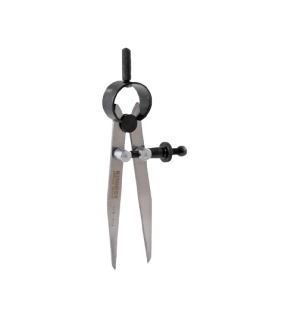
Manufactured from high quality polished steel. Ground finished points, a fine adjusting screw is mounted across the legs for setting the distance between the two points. A circular spring bow joins the legs, with a knurled extension attached for use when pivoting the dividers. Dividers are used for scribing arcs and circles, a light centre punch mark on the work keeps the pivot leg in the centre while marking.
Features and Benefits
• High quality polished steel with ground finished points
• Adjusting screw mounted across the legs for setting distance between points
• A light centre punch mark on the work keeps pivot leg in the centre while marking
• Ideal for use in scribing arcs and circle applications
Features and Benefits
• High quality polished steel with ground finished points
• Adjusting screw mounted across the legs for setting distance between points
• A light centre punch mark on the work keeps pivot leg in the centre while marking
• Ideal for use in scribing arcs and circle applications
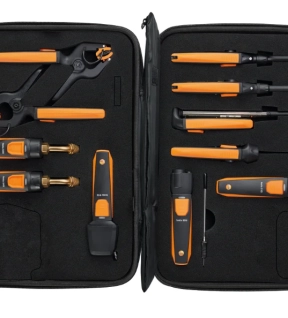
Ultimate kit for all-round engineers in the field of heating, air conditioning, refrigeration and ventilation: The kit contains all the testo Smart Probes and is ideal for carrying out functional checks or for plant maintenance, in conjunction with your smartphone/tablet. The testo Smart App enables you to work more easily and efficiently: Automatically calculate numerous parameters such as superheating/subcooling, target superheat, cooling/heating power or differential temperature. Measurement data reports can be emailed directly as a PDF or Excel file.
Your advantages
• For all measurements involving heating, air-conditioning, refrigeration and ventilation systems
• All Smart Probes for temperature, pressure, humidity and flow in one kit
• Display of measurement data progression as a graph or table
• Transmission and analysis of measurement data via testo Smart App
Your advantages
• For all measurements involving heating, air-conditioning, refrigeration and ventilation systems
• All Smart Probes for temperature, pressure, humidity and flow in one kit
• Display of measurement data progression as a graph or table
• Transmission and analysis of measurement data via testo Smart App
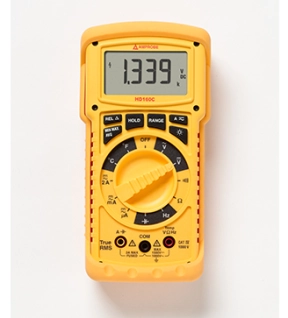
The Amprobe HD160C Heavy Duty Multimeter is designed for professional use in harsh environments. Its made using waterproof construction to prevent dirt, grime and moisture from entering the case and causing inaccurate readings or damaging shorts.
Built with tough, fire-retardant thermoplastic that is resistant to grease and chemical spills and with shock-mounted components that are drop resistant to at least 8 feet, the Amprobe HD160C is unusually rugged and reliable. It has an extended voltage measurement capability of 1500 V DC and 1000 V AC, unmatched by any other line of digital multimeters. The extended voltage ranges can withstand transients up to 12 kV, and it also measures temperature.
Built with tough, fire-retardant thermoplastic that is resistant to grease and chemical spills and with shock-mounted components that are drop resistant to at least 8 feet, the Amprobe HD160C is unusually rugged and reliable. It has an extended voltage measurement capability of 1500 V DC and 1000 V AC, unmatched by any other line of digital multimeters. The extended voltage ranges can withstand transients up to 12 kV, and it also measures temperature.
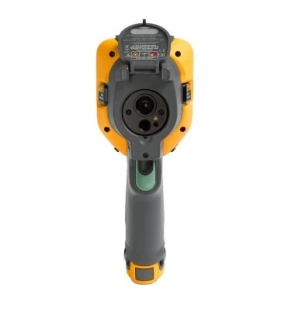
Boost your performance or your team's performance with 320 x 240 resolution. Infrared images captured with the TiS60+ record smaller temperature differences from a long distance. If you are new to thermal imaging or if your camera is being used by a team with varying levels of thermal imaging experience, the TiS60+ offers fixed focus with the ability to record quality images from a distance.
The TiS60+ lets you see what the eye cannot see and uncovers problems that other technologies can't detect. The TiS60+ is easy to use and can be a tool your team can rely on.
- Easy-to-use fixed focus
- 3.5 inch LCD screen
- The ability to take, review, and save images with one hand
- Fluke Connect™ compatibility for wireless sharing
Often, the next big challenge with infrared images is ensuring the images captured by the team can quickly be added to the work phase. The TiS60+ is
equipped with IR Photo Notes which makes this easy. This feature makes it easy for the camera operator to add a photo associated with the image documenting the name of the equipment and the room location associated with the thermal image so that the person creating the work order can send a technician to the correct location to perform repairs.
Be prepared with everything you need to lay the groundwork for your equipment, implement a preventative maintenance program and set working standards. The Fluke TiS60+ gives you the thermal data you need to get the job done.
The TiS60+ lets you see what the eye cannot see and uncovers problems that other technologies can't detect. The TiS60+ is easy to use and can be a tool your team can rely on.
- Easy-to-use fixed focus
- 3.5 inch LCD screen
- The ability to take, review, and save images with one hand
- Fluke Connect™ compatibility for wireless sharing
Often, the next big challenge with infrared images is ensuring the images captured by the team can quickly be added to the work phase. The TiS60+ is
equipped with IR Photo Notes which makes this easy. This feature makes it easy for the camera operator to add a photo associated with the image documenting the name of the equipment and the room location associated with the thermal image so that the person creating the work order can send a technician to the correct location to perform repairs.
Be prepared with everything you need to lay the groundwork for your equipment, implement a preventative maintenance program and set working standards. The Fluke TiS60+ gives you the thermal data you need to get the job done.